Field notesFebruary 2025 · based on a first-hand visit
Prices & rules last checkedJuly 2026
In −20°C air, palaces of ice glow in saturated color — the Ice and Snow World (Harbin Ice Festival) in China’s far northeast is the flagship of the world’s great ice festivals, a place where the cold itself is the attraction. This guide covers it end to end: how to do the festival, what to wear, and the Russian-flavored city that surrounds it.
The short version — plan backwards from Ice and Snow World at night
- The highlight is the illumination after sunset: the ice sculptures can be seen by day, but palaces glowing from within are another thing entirely. The most indulgent plan is to enter at 15:00–16:00 and watch day turn to dusk turn to night in one visit
- The festival runs from roughly mid-December to late February: the 27th edition opened on December 17, 2025, with standard adult tickets at RMB 328 (as of July 2026). Peak dates sell out — buy in advance
- Dress a level beyond ski-resort warm: it feels like −20 to −30°C. Phone batteries drain fast in the cold, so keep a power bank in an inside pocket
- Check visa rules early: China’s entry policies vary widely by nationality and change often — several passports currently enjoy visa-free short stays, while others need a visa or transit exemptions. Confirm the latest rules for your passport before booking (as of July 2026)
Ice and Snow World — an entire city built of ice

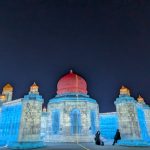
Ice and Snow World is not an exhibition of ice sculptures. It is a city made of ice — palaces, towers and ramparts assembled from hundreds of thousands of ice blocks, with people walking among them and slides running between them. Between the signature super ice slide (up to 521 m in the latest season — free, but expect queues), lookout towers you can freely climb, and nightly shows, four or five hours melt away. The 27th edition: opened December 17, 2025; standard adult ticket RMB 328; hours 10:00–21:30 (as of July 2026). Access is almost anticlimactic — Metro Line 2 to “Ice and Snow World” station, right at the gate. Buy tickets in advance through the official WeChat mini-program or platforms like Trip.com.

The festival food is its own attraction. Tanghulu — hawthorn and fruit dipped in sugar syrup — freezes on contact with the −20°C air, and the coating turns to a crackling shell. Eating a frozen street sweet in a frozen city is an experience that only exists at this temperature.
St. Sophia Cathedral and Central Street — the city Russia left behind

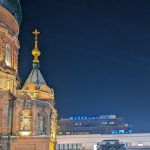
Harbin was built by Russians in the early 20th century as a hub of the Chinese Eastern Railway. Its symbol is St. Sophia Cathedral — green onion domes over red brick in Byzantine style, breathtaking under snow and night lighting. It now operates as the Harbin Architecture Art Museum (entry RMB 15–25, as of July 2026), and the exterior and the illuminated square are free. It is a 3–5 minute walk from “St. Sophia Church” station on Metro Line 1.

Ten minutes on foot from the cathedral is Central Street, a 1.5 km cobblestone pedestrian avenue lined with more than seventy European-style buildings from Renaissance to Art Nouveau — the air of the era when Harbin was called “the Moscow of the East.” Roses sealed in ice decorate the corners, steam rises from shops selling Russian bread and Harbin red sausage — and the local specialty is a Modern (Madie’er) ice pop, eaten outdoors below freezing. Ice cream in the cold — that’s the Harbin way.
The Songhua River — a frozen river that becomes a playground

Walk north past the end of Central Street and the Songhua River opens up, hundreds of meters wide. In deep winter it freezes solid and turns into a natural amusement park — slides, sleds and ice carousels right on the river. Across the water on Sun Island, the “Snow Expo” gathers monumental snow sculptures. Our most efficient day, road-tested: the river and Central Street by day, then Ice and Snow World from sunset.
Practical notes for Harbin
- Visas & arrival card — rules differ sharply by passport and change often. Several European nationalities currently have visa-free short stays; others need a visa or can use transit exemptions. Always check your government’s and China’s latest guidance before booking. Also, since November 20, 2025 every foreign visitor must register a China Digital Arrival Card — free on the National Immigration Administration’s official website or app, filed from 72 hours before arrival (passport and the address of your first night’s accommodation required; needed even under visa-free entry, and beware of unofficial sites that charge a fee)
- Getting there — most itineraries route through Beijing, Shanghai or Seoul. Harbin Taiping International Airport to the city is 40–60 minutes by airport bus or taxi
- Cold-weather kit — down plus a windproof shell, fleece-lined tights, snow boots, thick gloves and a knit hat are all mandatory. Hand warmers are sold locally. Phones discharge rapidly in the cold — carry a power bank and keep it warm against your body
- Payments — QR payment (Alipay / WeChat Pay) is standard down to the street stalls. Link an international credit card to either app and you can travel nearly cash-free
- Best season — the festival runs mid-December to late February. January is the peak for ice quality and event density (and also the coldest)
Where to go from here
- The country at a glance → China (Harbin) Travel Guide
- Ice at the other end of the earth → Iceland Travel Guide
- Compare all our destinations → Destinations
The history here
Why the places, the food and the artworks in this article are where they are.
Russia builds the Chinese Eastern Railway, and Harbin is born
The city began as a construction base for the railway, and the cobblestones and European facades of Central Street are what the Russians brought with them. St. Sophia Cathedral was founded in 1907; the present building dates from 1932. From 1932 to 1945 the city lay inside Manchukuo.
📍 If you go
The Harbin International Ice and Snow Festival begins
It grew out of ice lanterns — candles set inside hollowed-out blocks of ice by fishermen on the Songhua River — which became a lantern fair in 1963. The ice city, cut from the river each winter, is built to be melted.
📍 If you go


