Field notesNovember 2022 and April 2025 · two first-hand trips
Prices & rules last checkedJuly 2026
Bangkok keeps evolving — from “Asia’s cheap and cheerful capital” into one of the world’s great entertainment cities. Golden temples, legendary street food, and Muay Thai at the source: for sheer density, nowhere in Asia beats it. This guide lays out the backbone of a first Bangkok trip — the three great temples, Muay Thai, and the food.
The short version — a three-night template
- Day 1 = the three great temples: the Grand Palace + Wat Phra Kaew in the morning → walk to Wat Pho → cross-river ferry (5 baht) to Wat Arun. Night market in the evening
- Day 2 = a day trip to Ayutthaya (see our full guide): just over an hour each way by train. Close the day with Muay Thai at the stadium
- Day 3 = the city itself: markets and street food, a massage, the Chao Phraya river. With a late-night flight home you get the full day
For entry, every foreign visitor must pre-register the free TDAC digital arrival card (from 72 hours before arrival; the only legitimate site is tdac.immigration.go.th). In the city, combine the BTS/MRT trains with ride-hailing apps (all as of July 2026).
The three great temples — Grand Palace, Wat Pho and Wat Arun in half a day

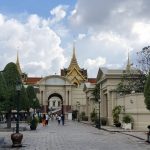
The three key temples of Bangkok cluster along the Chao Phraya river. Start with the Grand Palace + Wat Phra Kaew (the Emerald Buddha temple; 500 baht combined) — the sanctum of the Thai monarchy, an explosion of gilded stupas and polychrome ornament that is “Thailand” at maximum intensity. The dress code here is the strictest: no shorts, no sleeveless tops. Within walking distance, Wat Pho (300 baht, cash only) holds the 46-meter golden Reclining Buddha, and the cross-river ferry — 5 baht per person — carries you to Wat Arun, the Temple of Dawn (200 baht, cash only), on the far bank. That river crossing from temple to temple was, for us, the most Bangkok-like part of the whole route (all prices as of July 2026).

Muay Thai at night — Rajadamnern is a festival of fighting

If you pick only one thing for a Bangkok night, we say without hesitation: watch Muay Thai. Rajadamnern, the world’s oldest dedicated Muay Thai stadium, has been reborn as the modern “RWS” promotion — laser lighting, big sound, and nearly four hours of fights from the first bout on. The ritual wai kru gives way to the tension of elbows and knees at close range — the fever around the ring exists nowhere but here. Box-office prices run from about 2,000 baht ringside to 1,000 baht third class, and buying online in advance is the safe play (same-day street sellers charge a premium; as of July 2026). Traffic around the stadium is heavy — leave margin before the first bell.
The food — the pink chicken-rice shop and a sea of street stalls

Bangkok eats at stalls and no-frills diners. We queued at Pratunam’s famous “pink kaomangai” — the poached-chicken-rice institution known for its pink uniforms — where a bowl of silky chicken and ginger sauce costs pocket change and delivers pure happiness. Beyond that, you will run out of meals before you run out of must-try dishes — start with pad thai, massaman curry and mango sticky rice. At night, head for the night markets — the giant train-market complexes and the street food of Yaowarat (Chinatown) turn eating itself into the evening’s entertainment.
Getting there and where to stay
Bangkok is one of Asia’s best-connected hubs, with direct flights from cities worldwide. In town, the BTS Skytrain and MRT metro cover the visitor districts and beat the traffic. For hotels, the BTS corridor from Siam to Asok is the all-purpose choice; the riverside suits resort-mode stays. The old town around the three temples sits away from the rail lines, but MRT Sanam Chai station has made it far more practical.
Practical notes for Bangkok
- Entry (TDAC) — the digital arrival card is mandatory for all foreign visitors. Register free from 72 hours before arrival and show the QR code (beware paid imitation sites)
- Temple dress — cover shoulders, knees and ankles. The Grand Palace enforces strictly; cover-ups are sold at the gate, but bringing your own is surer
- Cash — entry to Wat Pho and Wat Arun, the ferry, and the stalls are cash-only. Carry plenty of small baht notes
- Best season — the dry months from November to February. April is the hottest of the year and Songkran (Thai New Year water festival) puts the whole city in another mode
- Getting around — BTS/MRT plus ride-hailing (Grab etc.). In street taxis, make sure the meter is on
Where to go from here
- The country at a glance → Thailand Travel Guide
- Compare all our destinations → Destinations
- The ancient capital, one hour away → Ayutthaya day trip guide
The history here
Why the places, the food and the artworks in this article are where they are.
Rama I moves the capital to Bangkok
A new capital built across the river after the loss of Ayutthaya. The Emerald Buddha was installed in Wat Phra Kaew inside the Grand Palace. Wat Arun was the royal temple before the move; the reclining Buddha of Wat Pho dates from Rama III. The three great temples belong to three different reigns.
📍 If you go


