Field notesMay 2023 · climbed all 366 steps of the spiral staircase first-hand
Prices & rules last checkedJuly 2026
Bruges, the medieval city they call an open-air museum. The 83-meter belfry (Belfort) rising at its center is the one place in town where you can look down on the medieval streetscape. Here is the full picture, from getting tickets to what waits at the top.
The short version — three rules for the climb
- Tickets are timed-entry (€15): admissions are tightly capped, and in high season the same-day slots vanish. Booking online in advance is effectively mandatory
- The 366 steps are too narrow to pass comfortably: the upper stretch is a stone spiral where your shoulders brush the walls. Wear solid shoes and carry as little as possible
- The climb is unconditionally worth it: a sea of orange roofs, the gabled fronts of the Markt, the canals — from up here you understand at a glance why Bruges is still “medieval”
- For the overall plan of a Bruges visit, start with the Bruges travel guide
What the belfry is — a World Heritage civic tower
The Bruges belfry, begun in the 13th century, is not a church tower but a civic tower. It stored the city’s charters and rang out the hours, fires and enemy attacks — the heart of a medieval city — and it is inscribed as UNESCO World Heritage among the belfries of Belgium and France. Inside, a 47-bell carillon is still in active service, dropping a melody over the town every 15 minutes. The climb passes the treasury and the bell mechanism room on the way up, so this is not a mere viewing platform — it is the tower’s history climbed with your own legs.
Beyond the 366 steps — a sea of orange rooftops


Step out at the top (strictly, the viewing floor below the bell chamber) and you get orange rooftops and canal water through 360 degrees. Windmills toward the North Sea, the Church of Our Lady (115.6 m) — one of the tallest brick towers on earth — to the south, and directly below, the guild houses of the Markt. People love to say Bruges stopped its clock in the 15th century; the phrase only truly lands from up here, not at street level. You shoot through wire mesh, so the trick is to press the lens against the grid and open the aperture. Time your visit to the top of the hour and you experience the carillon with the bells’ vibration coming up through the floor.
Practical notes for the climb
- Tickets — €15, timed entry (book ahead on the official site). The Musea Brugge Card (€33) covers the belfry plus the Groeninge Museum and other municipal museums — pays for itself once you visit two or more sites (as of July 2026)
- Steps and time — 366 steps; about an hour for the round trip plus time at the top. The upper spiral is narrow and you will wait for people coming down
- Best time — first thing in the morning (before the day-trippers arrive) or late afternoon. Around the top of the hour you catch the carillon playing
- Cautions — no elevator; no strollers or large bags. If tight or high places are not for you, the belfry seen from the Church of Our Lady side — looked up at, not down from — makes a fine picture in itself
- Location — south side of the Markt. About 20 minutes on foot from Bruges station, or a few minutes by bus
How it compares with other towers — what to weigh before climbing
There are towers with a lot of stairs everywhere, but the combination of step count, price and booking constraint differs a great deal from town to town. Line it up against the others and the character of the Bruges belfry comes clear.
- The Bruges belfry — 366 steps, €15, timed entry. Numbers are capped, so in high season the same-day slots vanish and booking online in advance is effectively compulsory. For two museums or more, the Musea Brugge Card (€33) includes it (as of July 2026)
- Cologne Cathedral’s south tower — 533 steps, €6, no lift. More steps, but cheaper, and with no booking constraint. What it shares is that first thing in the morning, before the crowds and the heat, is the right answer (%s)
- Copenhagen’s Round Tower — 34.8 m, 40 DKK, no booking. There are almost no stairs inside; a spiral ramp of seven and a half turns takes about ten minutes. It is among the lowest barriers to “climbing” anywhere (%s)
- So the Bruges belfry is the type where the paperwork is heavy for the number of steps. Before fitness, whether you can get a slot decides whether you go at all
Which also means that once the slot is secured, the rest is only a matter of legs. How to work the whole town is in the Bruges travel guide, and the eating to slot into the same day in the Bruges food guide.
There are really only two things to decide before climbing: the date and time of your slot, and how you fill the hours either side. Being timed entry, it cannot be moved for the weather or how you feel on the day. Which is also to say that once the slot is yours, all that is left is 366 steps — physically it is not a tower that needs special preparation. The waiting can go on waffles at the stand in the square, so keeping the 30 minutes either side of your slot as time with nothing in it is what makes a day in this town run best.
Where to go from here
- The overall plan for the city → Bruges travel guide
- Waffles and beer after the climb → What to eat in Bruges
- The country at a glance → Belgium Travel Guide
- Pick your next trip by the view → Scenic travel destinations
The history here
Why the places, the food and the artworks in this article are where they are.
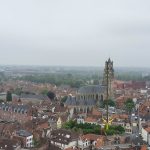
Bruges rebuilds its belfry after a fire
The belfry belonged to the citizens rather than the church: proof of self-government and a strongroom for the town’s charters. Bruges prospered as the trading center of the north in the fifteenth century, then declined when its sea channel silted up. Because it declined, the medieval city stayed as it was.
📍 If you go


