Field notesMay 2023 · first-hand visit, including the interior and the 533-step south tower climb
Prices & rules last checkedJuly 2026
Step out of Cologne’s central station and your field of vision is walled off by black rock — 157 meters tall, 632 years from first stone to completion. No photograph can reproduce that first impression of Cologne Cathedral. This guide covers the highlights, how to handle the tower climb, and the tourist admission fee introduced in July 2026.
The short version — visiting in the €12 era
- Tourist admission is charged from July 2026: adults €12, students 14 and over €6, children 13 and under free (entry for worship remains free). Buying online is recommended; on-site purchase also works. The scheme is brand new and the rules may shift — check the official site before you visit
- Do the south tower (533 steps, €6) first thing, while your legs are still fresh: no elevator, and a spiral staircase with barely room to pass. You want to climb before the crowds and before the heat
- The star inside is the Shrine of the Three Kings: this golden reliquary is the reason the cathedral was built at all. Go all the way to the back of the choir
- One minute from the station = the king of layover sightseeing: even a 90-minute ICE connection is enough to see the interior. The perfect starting point for a Rhine Valley trip
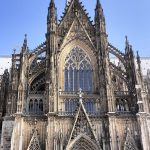
The west facade — 632 years to an “unfinished” perfection

Construction began in 1248 and — through long interruptions for lack of money — finished only in 1880, built faithfully to the medieval plans across 632 years: the summit of Gothic architecture. There is a modern chapter too: inscribed as a World Heritage Site in 1996, it was placed on the endangered list from 2004 to 2006 over nearby high-rise plans, delisted only after the city imposed building-height limits. The blackened exterior is sandstone discolored by exhaust and the elements, and restoration continues to this day — hence the saying that the scaffolding is part of the cathedral.
Inside — the nave, the stained glass and the golden altarpiece


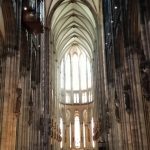
Step inside and the 43-meter nave pulls your gaze upward by force. The stained glass of the side aisles runs from the medieval glass and the 19th-century Bavarian windows to Gerhard Richter’s south transept window, its shattered colors arranged like pixels — a chronicle in light. In the Lady Chapel hangs Lochner’s Altarpiece of the City Patrons, the peak of the Cologne school of painting. And at the far end of the choir, glowing gold, stands the Shrine of the Three Kings — the cathedral was built to house the relics of the Magi, brought here from Milan in the 12th century. One of Europe’s largest golden reliquaries, it is the very reason pilgrims sustained 632 years of construction.
The south tower — 533 spiral steps and the bell chamber


If your legs are willing, take on the south tower climb (€6, roughly 100 m up). The entrance is below ground to the right of the facade, and the 533-step spiral staircase has no elevator. In the bell chamber partway up, you pass right alongside “Decke Pitter” (the St. Peter’s bell, about 24 tonnes), one of Europe’s largest free-swinging bells. From the viewing level: the Rhine, the Hohenzollern Bridge, and the red roofs of the old town stretching into the distance. The stairs are too narrow to pass comfortably, so a friendly “Hallo!” as you squeeze by is the climbing etiquette here. Back at the bottom, the Treasury (€6, or €8 combined with the tower) in the vaults on the station side holds a collection of reliquaries reaching back to the 4th century (as of July 2026 — subject to change under the new ticketing scheme).
The closing shot — Hohenzollern Bridge and the love locks

Close the visit behind the cathedral at the Hohenzollern Bridge. Walk the footpath of the railway bridge — its railings packed with hundreds of thousands of love locks — to the far bank, then turn around: the twin spires floating above the river are Cologne’s most famous view, and it is at its best at dusk. Back across the bridge, finish with a glass of Cologne’s own Kölsch at an old-town brewery (fair warning: empty your 200 ml glass and the next one arrives without a word).
Practical notes for Cologne Cathedral
- Admission — tourist entry costs €12 for adults from July 2026, €6 for students 14 and over, free for children 13 and under, free for worship (online purchase recommended; the scheme is new, so confirm the latest on the official site)
- South tower — €6, 533 steps, no elevator. May–Sep 9:00–18:00; Mar, Apr and Oct until 17:00; Nov–Feb until 16:00 (last entry 30 minutes before closing)
- Treasury — €6 (€8 combined with the tower); entrance in the vaults on the station side; closed on certain days, such as during Carnival
- Dress and luggage — no overly bare shoulders or knees; men remove hats; no suitcases inside (use the station lockers)
- Photo tips — for the full facade, shoot from the top of the station steps or from the far bank of the Rhine. Inside, handheld photography is allowed within the posted limits; no tripods
Pair it with the Rhine valley — do not let it end at the cathedral
Cologne is also the gateway to the Rhine valley. Deciding in advance how you move after the cathedral changes how the day gets used.
- The castle cruise needs no booking: KD’s Rudesheim to St Goar, about €27 one way, can be bought at the pier on the day, and showing a Deutsche Bahn ticket gives up to 20% off. Unlike the cathedral, you are not tied to a reservation (as of July 2026)
- But it does not run in winter (late October to early April). If the cruise is the axis of the trip, you have to fix the month before the dates
- Tower in the morning, boat in the middle of the day: the south tower is 533 steps with no lift, so first thing — before the crowds and before the heat — is the right answer. The boat suits the hours when daylight is on the water
The details are in the complete Rhine cruise guide and the Cologne and Rhine valley 4-day itinerary.
Frequently asked questions
How many steps are there up Cologne Cathedral?
The south tower is 533 steps. There is no lift, and the spiral staircase is too narrow to pass comfortably, so first thing in the morning — before the crowds and the heat — is the civilised time to climb. The entrance is below ground to the right of the west front, it costs €6, and the platform sits at about 100 m. On the way you pass the bell chamber and the roughly 24-tonne “Decke Pitter”.
Do you have to pay to enter Cologne Cathedral?
Tourist admission has been charged since July 2026: €12 for adults, €6 for students aged 14 and over, free for children 13 and under. Entry for worship remains free. Buying online is recommended but tickets are also sold on site. The scheme is new and the rules may shift, so check the official site before you visit.
Can I see it during a short rail connection?
Yes. The cathedral is one minute on foot from the exit of Cologne Central Station, so a 90-minute ICE connection is enough for the nave. Add the south tower or the treasury and you will want more margin.
When was Cologne Cathedral finished?
Building began in 1248 and, after breaks caused by lack of money, was completed in 1880 — 632 years, built faithfully to the medieval plans. The towers reach 157 m. After the 1996 World Heritage listing it was placed on the danger list in 2004–06 over nearby high-rise plans, and removed once the city introduced height limits.
Where to go from here
- The trip this fits into → Cologne and the Rhine Valley — a 4-day itinerary
- The next day, cruise past the castles → Rhine River cruise guide
- The country at a glance → Germany Travel Guide
- Choose your destination through history → Destinations chosen by history
The history here
Why the places, the food and the artworks in this article are where they are.
The relics of the Three Kings are moved from Milan to Cologne
After Emperor Frederick I subdued Milan, the archbishop of Cologne brought the relics home. Pilgrims arrived from all over Europe, and the cathedral was commissioned as the vessel to hold them. The golden shrine still stands behind the high altar.
📍 If you go
Cologne Cathedral: 632 years from the first stone to the last
Work stopped in the Middle Ages and a crane stood abandoned on the south tower for over three centuries. In the nineteenth century Prussia finished it as a national project, following the medieval drawings. Climbing the 533 steps of the south tower is one way to count those 632 years.
📍 If you go
The thousand-bomber raid leaves Cologne in ruins
On the night of May 30 the RAF sent a thousand aircraft over the city. The cathedral took fourteen bombs and stayed standing; the photograph of its spires above the rubble became a symbol of the post-war years. Almost everything else you see was rebuilt.
📍 If you go


