Field notesMay 2023 · sailed this stretch on a scheduled KD (Köln-Düsseldorfer) boat
Prices & rules last checkedJuly 2026
Each time the boat pushes on, another old castle appears on the hills above — the Rüdesheim to St. Goar stretch of the Rhine is the prime stretch, thickest with castles in the World Heritage Upper Middle Rhine Valley. Here is the day in sequence: how to board, where to sit, and what comes into view when.
The short version — sail Rüdesheim to St. Goar, downstream
- The optimal leg is the roughly 100 minutes from Rüdesheim to St. Goar: Pfalzgrafenstein, the Loreley and Katz Castle come one after another, and heading downstream (northbound) rides the current, so it is also quicker
- KD one way about €27, no booking needed: same-day tickets are sold at the pier window. Showing a DB (Deutsche Bahn) rail ticket earns up to 20% off; scheduled boats do not run in winter (late October to early April) (as of July 2026)
- Claim the right-hand side of the deck, facing forward: the Loreley rock and Katz Castle pass to starboard. Castles appear on both banks, though, so a spot you can move from beats a fixed seat
- Pair the landing with Rheinfels Castle: lunch in the hilltop castle ruins above St. Goar, then the Boppard chairlift, then the train back to Rüdesheim — that loop is the route we actually ran
Boarding — the pier, the ticket and a morning bretzel

From Frankfurt it is about 1 hour 40 minutes on a local train to the wine town of Rüdesheim. The KD pier sits right on the riverbank; say “one way to St. Goar” at the window and you are aboard within minutes (about €27 one way, as of July 2026). We took the 11:00 sailing, arriving 12:40 — pick up a bretzel and coffee at the bakery near the station beforehand, and the deck becomes the best café seat on the river. There is a kiosk and toilets on board, so travel light.
The first act — the Mouse Tower and castle-spotting by binoculars


Shortly after departure, the Mouse Tower appears on its islet off Bingen. From here the castle rush begins — Rheinstein, Reichenstein, Sooneck — a new castle rising on the hills every few minutes, then slipping astern. Look through the ship’s mounted telescope or your own binoculars and you can even tell the ruins from the ones operating as hotels; idle scenery-watching turns into a castle observation session. The Riesling vineyards spread across every slope are another view that belongs to this stretch alone.
The mid-river highlight — Pfalzgrafenstein, the castle afloat

Off Kaub, a white castle appears to float in the middle of the river — Pfalzgrafenstein Castle. The Holy Roman Emperor built it on the islet in 1327 to collect tolls on Rhine shipping, and its ship-like pentagonal plan was designed to deflect ice floes and driftwood. This is the most picturesque moment of the cruise, so have the camera ready a little before. Gutenfels Castle shows on the hill opposite at the same time.
The Loreley — a legend above the river’s 113-meter squeeze

Late in the run, a rock wall closes in to starboard: the Loreley. It rises 132 meters over the narrowest (about 113 meters) and fastest-flowing passage on the Rhine, and the many ships lost here bred the legend of a singing maiden on the rock who lures sailors to their ruin. Boats often play the “Song of the Loreley” — Heine’s poem set to melody — as you approach; the few minutes passing directly beneath the rock, German song in the air, are the climax of the route.
Ashore at St. Goar — Katz Castle and lunch at Rheinfels


At 12:40 we stepped ashore at St. Goar, seen off by Katz Castle, the “Cat Castle,” on the hill across the water. From here, the move is Rheinfels Castle, looming behind the town (entry around €5, a roughly 20-minute walk or a shuttle van) — one of the largest fortress ruins in the Rhine valley, where the Flammkuchen (a thin Alsatian-style tart) at the terrace restaurant, eaten looking down the gorge, was exceptional. The ruined sections are on a scale you cannot fully explore even in half a day.
The way back — chairlift and cable car
First double back downstream to Boppard for the Boppard chairlift (€11 return, April–October) up to the viewpoint over the Rhine’s greatest bend, then ride the train south again toward Rüdesheim — or head straight back and glide over the vineyards on the Rüdesheim cable car (€12 return; running March 21 to November 1 in 2026) to the Niederwald Monument. In the evening, a Riesling and the local Rüdesheimer Kaffee in the Drosselgasse lane complete the full course — river, castles, hills and wine in a single day (as of July 2026).
Practical notes for the Rhine cruise
- Fares and booking — KD Rüdesheim to St. Goar about €27 one way (return roughly +€3); same-day tickets at the pier; up to 20% off with a DB rail ticket (as of July 2026)
- Season — no scheduled boats in winter (late October to early April). Best from May to October, when the vineyards are green
- Deck tactics — head early for the upper open deck, right-hand side. Sun protection (hat, sunglasses) is essential, and the river wind is cold even on clear days, so bring a layer
- Timing — about 100 minutes on the water + 2 hours at Rheinfels Castle + 2 hours for the Boppard detour fits neatly into a Frankfurt-based day trip
- Luggage — leave the big bags at your Frankfurt hotel and go light; both boat and castle involve plenty of stairs
Where to go from here
- The full trip design → Cologne & Rhine Valley Itinerary
- The base city → Frankfurt Travel Guide
- The country at a glance → Germany Travel Guide
- Choose your next trip by scenery → Scenic Travel Destinations
The history here
Why the places, the food and the artworks in this article are where they are.
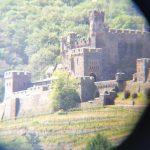
The Nine Years’ War leaves the Rhine castles in ruins
Louis XIV’s army burned castles and towns as it withdrew. In the nineteenth century the ruins were loved as romantic scenery and some were rebuilt as aristocratic residences. The castles you pass on a cruise are a mix of the ruined and the reimagined.
📍 If you go
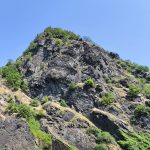
Heine writes “Die Lorelei”
The rock had always marked a dangerous narrows; the maiden who lures sailors to their deaths was invented by Brentano in 1801. Heine’s poem and Silcher’s tune carried it around the world, and made a landmark out of a rock.
📍 If you go


