Field notesMay 2023 · based on a first-hand two-hour visit
Prices & rules last checkedJuly 2026
The place where you can get closest to Van Gogh is not the France where he spent his last four years, but the country where he was born and raised — the Netherlands, in Amsterdam. The Van Gogh Museum holds the world’s largest collection — about 200 paintings and more than 500 drawings — and lets you follow his ten working years as a painter in chronological order. This guide covers how to get tickets, how to route the visit, and the works you cannot miss.
The short version — the ticket is the whole battle
- Timed entry only, online only: there is no ticket window. Adults around €25 (dynamic pricing · special exhibitions included), and same-day tickets routinely sell out in busy periods. Book the moment your dates are fixed (sales open six months ahead)
- Going up a floor means moving forward through his life: the permanent collection runs almost chronologically — the Dutch years → Paris → Arles → the final years. Walk the route in order and you leave with the density of a full biography
- Allow 2–3 hours: the crowds peak from 11:00 to 15:00. Aim for the first slot of the morning or the Friday late opening
- Photography is allowed (no flash, tripods or selfie sticks; personal use only). In the crush, though, there are plenty of moments when it is better to simply burn the picture into memory
Highlight 1 — Almond Blossom

The face of this museum is Almond Blossom, painted on the news that his brother Theo had a son. The soaring sky-blue and the white flowers seem impossible for a late work made in the depths of his mental crisis — and the composition of the branches, learned from Japanese ukiyo-e prints, makes it an emblem of Van Gogh’s relationship with Japan. It is also the runaway favorite in the museum shop, if you need a benchmark for souvenir hunting.
Highlight 2 — the self-portraits, and “Japan”

Too poor to hire models, Van Gogh used the man in the mirror as his practice subject. The Paris-era self-portraits hang like a laboratory notebook — color exploding, canvas by canvas, out of the dark Dutch years. The other axis is Japan: Courtesan, his copy after a print by Keisai Eisen (it also appears in our Amsterdam itinerary), shows exactly what color the Japan of his dreams was. For us as travelers from Japan, standing in front of it — his vision of a country he longed for but never reached — was a strange and memorable reversal, of a kind only this museum can stage.
Highlight 3 — orchards, the sea, and the light of Arles


When Van Gogh moved to Arles, the first thing that consumed him was the spring series of flowering orchards — peach, apricot and plum blossoming all at once, a southern spring he painted as his own image of a Japanese one. At the other end of his career, the early seascape at Scheveningen was painted on a storm-blown beach, and the story goes that real sand is mixed into the paint — standing before the canvas, you can reconstruct the weather of the day it was made. That is what seeing the originals is for.
Highlight 4 — Van Gogh, as Gauguin painted him

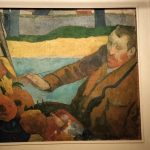
The shared life with Gauguin in the Yellow House at Arles collapsed after barely two months, ending in the incident in which Van Gogh cut off part of his own ear. Painted in the middle of that storm, Gauguin’s Van Gogh Painting Sunflowers hangs here — Van Gogh himself said the portrait showed him “tired and charged with madness”. A single picture of Van Gogh through another’s eyes, embedded among his own works: it is the finest stroke in the whole display.
GetYourGuide
Secure a timed-entry ticket for the Van Gogh Museum
Fully pre-booked, and same-day tickets routinely sell out. Book timed-entry tickets or guided tours online.
See tickets →Van Gogh Museum practical notes
- Tickets — timed entry only, online only, adults around €25 (dynamic pricing · special exhibitions included / multimedia-guide bundles available) · free for ages 0–17 (as of July 2026). Enter within 30 minutes of your slot
- Booking tips — on sale six months ahead. If sold out, guided-tour slots or the Friday late opening sometimes still have space
- Time and crowds — 2–3 hours. The first morning slot or after 16:00 is comparatively calm. Large bags are not allowed inside (lockers available)
- Photography — allowed (no flash, tripod or selfie stick; personal use only). For the works’ protection, stay outside the distance lines
- Nearby — the Rijksmuseum (Vermeer, Rembrandt) shares the same Museumplein: 400 years of Dutch painting, doubled up in one day
What to put on the same day — how to use the hours either side of the museum
The Van Gogh Museum runs on entry within 30 minutes of your stated time, so it is safer to keep whatever sits either side of it movable.
- Tickets are strictly timed and online only, with no box office. Around €25 for adults (dynamic, including special exhibitions), free for ages 0 to 17. On sale six months ahead, and when it is sold out guided-tour slots or the Friday evening extension may still have space (as of July 2026)
- Walking and the tram are enough in the city: trains, buses and trams take contactless card payment (OVpay), so you do not need to build queueing at a ticket machine into the plan
- Do not put it on the same day as a day trip: Giethoorn is 2 to 2.5 hours each way, so combining it with a timed museum slot breaks down. Keep the museum day inside the city and it stays safe
- For three days and two nights, the minimum shape is: one day for the city plus the museum, one day for Giethoorn, and half a day to a day for Zaanse Schans plus Utrecht
- Ages 0 to 17 are free, so families can predict the cost per head. But even a free ticket needs a timed slot
How to build it is in the Amsterdam and Giethoorn 3-day itinerary.
Frequently asked questions
How long do you need at the Van Gogh Museum?
Allow 2–3 hours. The permanent collection runs roughly in chronological order — the Dutch years, Paris, Arles, the final period — so walking the route in order leaves you with the density of a full biography. The crowds peak from 11:00 to 15:00, so first thing in the morning or the Friday late opening is the sweet spot.
Can I buy tickets on the day?
There is no ticket desk: entry is online only with a fixed date and time. Adults pay around €25 under dynamic pricing (special exhibitions included), and same-day tickets routinely sell out in busy periods. Booking opens six months ahead, so reserve as soon as your dates are fixed (as of July 2026).
Is photography allowed inside?
Yes, for personal use. Flash, tripods and selfie sticks are not permitted. When it is busy, though, there are plenty of moments where looking rather than shooting serves you better.
Which works should I not miss?
“Almond Blossom” (1890), painted to celebrate the birth of his brother Theo’s son, is the face of the museum. Beyond that: the Paris self-portraits, where the colour visibly detonates; “The Courtesan”, his copy of a Keisai Eisen woodblock print; the Arles orchard series; and Gauguin’s “Van Gogh Painting Sunflowers” — a single portrait of Van Gogh seen through someone else’s eyes, set among his own work.
Where to go from here
- The country at a glance → Netherlands Travel Guide
- The full trip design → Amsterdam & Giethoorn itinerary
- Next day, out to the village on the water → Giethoorn travel guide
- Choose your destination by art → Art & architecture destinations
The history here
Why the places, the food and the artworks in this article are where they are.
Van Gogh goes to Arles
A little over a year of painting in the south of France produced the Sunflowers series. The one in Amsterdam is a repetition made in 1889. He worked as a painter for only ten years, and the museum walks you through those ten years in order.
📍 If you go


