Field notesNovember 2023 · based on a first-hand walk through Macau
Prices & rules last checkedJuly 2026
One hour by ferry from Hong Kong, across the water, is a city where pastel colonial architecture and cobbled squares share space with some of the world’s biggest casino resorts. Here is a model course for making the most of Macau on a day trip (or, better, one night). The World Heritage historic center is astonishingly compact — and most of it is free (fees and rules as researched in July 2026).
The short version — the peninsula by day, Cotai by night
- The historic center walks in half a day: the World Heritage “Historic Centre of Macao” (inscribed 2005) comprises 22 buildings and 8 squares, nearly all within walking range of Senado Square. Most are free to enter
- Ride the casino hotels’ free shuttles hard: free buses run frequently between the ferry terminals and each resort. Combine them with the public buses (6 patacas) and transport costs stay close to zero
- No currency exchange needed: Macau runs on the pataca (MOP), but Hong Kong dollars are accepted at near-par
- For a day trip: World Heritage on the peninsula by day, Cotai from late afternoon: you can watch the night illuminations and still make the last ferry back to Hong Kong
Senado Square — a heritage walk that starts on rippling cobbles


Start at Senado Square — the heart of sightseeing in Macau, where lemon-yellow and pink colonial facades play off the wave-patterned stone paving (calçada) laid by Portuguese craftsmen. Facing the square stands the pure-white Santa Casa da Misericórdia, headquarters of one of Asia’s oldest charitable institutions (founded 1569) — and this scenery, southern Europe folded into China, is precisely the value that put the “Historic Centre of Macao” on the World Heritage list. From here the sights run in a chain: the iconic Ruins of St. Paul’s (only the cathedral’s facade survives; 8 minutes on foot) and the Mount Fortress beyond.
The Cathedral and St. Dominic’s — rooms of prayer hidden in the lanes


A few minutes down the lanes from Senado Square, 17th-century church architecture starts appearing, one building after the next. The cream-yellow St. Dominic’s Church (founded 1587, a baroque masterpiece); the Cathedral, where successive governors held their inaugurations — both free to enter, and one step inside, the air changes completely from the clamor of the square. The historic center’s churches and temples don’t dot the map so much as crowd it, so put the map app away and navigate by the feel of the lanes — that is the Macau way to enjoy it.
Egg tarts and Macanese food — tasting Macau’s Portuguese roots

Macau’s food is a 400-year-old fusion of Portugal and Canton. For lunch, find a Macanese diner — African chicken, croquettes of bacalhau (dried salt cod), seafood stewed in tomato and served over rice: combinations you will meet nowhere else. Then, after lunch, the egg tart. The two great names are Margaret’s Café e Nata, five minutes on foot from Senado Square (closed Wednesdays), and the originator, Lord Stow’s Bakery (main shop in Coloane, with a branch in The Venetian). Figure 8–11 MOP apiece — crisp pastry, scorched custard, and fresh from the oven is the only correct answer (as of July 2026).
Cotai from late afternoon — the Venetian’s canals and gondolas

As the light softens, take a free shuttle to the Cotai district. Inside The Venetian Macao, an uncannily convincing canal flows beneath a painted blue sky, plied by gondolas (standard canals: adults 158 MOP weekdays / 168 MOP weekends; the serenaded Grand Canal ride: 208/218 MOP, as of July 2026). Add the Eiffel Tower at The Parisian Macao next door and the hotels’ light displays, and Macau’s double life — the 16th century by day, the 21st by night — completes itself in a single day. The last ferries to Hong Kong run past 11 p.m., so you can watch the illuminations to the end and still get home (confirm the day’s timetable).
Practical notes for a Macau day trip
- Getting there — about 1 hour by ferry from Hong Kong (figure HK$160–200). For the heritage district take a boat to the Outer Harbour; for Cotai direct, sail to Taipa. The Hong Kong–Zhuhai–Macau Bridge shuttle bus (HK$65, 24 hours) is another option. There are immigration checks, so bring your passport
- Getting around — free casino-hotel shuttles (ferry terminals to each resort) plus public buses at 6 patacas. The historic center is covered on foot
- Currency — the pataca (MOP) is the local tender, but Hong Kong dollars pass at near-par. Short visits need no exchange (change may come back in MOP)
- A model day trip — morning: ferry to the Outer Harbour, then Senado Square, the Ruins of St. Paul’s and the churches / lunch: Macanese food plus an egg tart / late afternoon: free shuttle to Cotai, The Venetian and The Parisian by night, last ferry back
- Dress notes — casino floors may refuse flip-flops and shorts; keep voices low inside the churches
Where to go from here
- The region at a glance → Hong Kong and Macau Travel Guide
- The full trip design → Hong Kong and Macau 3-Day Itinerary
- The Hong Kong side, plate by plate → What to Eat in Hong Kong
- Compare all our destinations → Destinations
The history here
Why the places, the food and the artworks in this article are where they are.
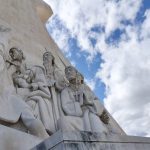
Portuguese sailors are wrecked on Tanegashima, and firearms reach Japan
The eastern end of the Age of Discovery route was Japan. Guns arrived first, then Christianity and Portuguese sweets, all by the same sea route. Standing at the Monument to the Discoveries in Belém, you are standing at the other end of it.
📍 If you go
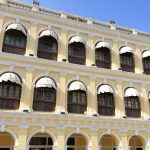
Portugal is allowed to settle at Macau
Ming China permitted a settlement, and it became the hinge of East Asian trade. The Jesuits began St. Paul’s in 1602; a fire in 1835 left only the facade. The wave-patterned pavement of Senado Square is the same design as Lisbon’s.
📍 If you go
The Macanese egg tart is invented
The British pharmacist Andrew Stow remade the Portuguese pastel de nata with English custard. Portugal to Macau, then — in an Englishman’s hands — to Hong Kong and across Asia. One pastry summarizes 450 years of rule.
📍 If you go


