Marmalade, molasses, veranda, cobra. English carries a scattering of words that came in from Portuguese, because five hundred years ago a small country on the western edge of Europe went to sea and its routes reached the far side of the world. This page follows the Age of Discovery through places you can still stand in today. The card under each chapter leads to the article for getting there.
In short
- Portugal, a small country at the edge of Europe, went to sea to reach the spices directly.
- The route rounded the Cape of Good Hope to India, and ran on to its eastern end in Japan. Firearms, Christianity and sweet pastries all came the same way.
- The lead passed to the Dutch, the empires withdrew, and the pastries and the words stayed behind.
1 Why the small country at the edge of the world went first
Fifteenth-century Portugal was a country of roughly a million people. The wealth of Europe ran through the Mediterranean, and spices came overland and by the Arabian Sea into the hands of Venetian and Genoese merchants. Portugal had only the Atlantic; it was outside that system, and going out into the outer sea was the one move available to it.
In 1415 Portugal took Ceuta, the Muslim-held port across the Strait of Gibraltar. One of the princes on that expedition would later be called Henry the Navigator, and from then on he kept sending ships down the west coast of Africa. Cape Bojador was feared as the point where the sea was said to boil; when the sailor Gil Eanes rounded it in 1434 the psychological wall broke, and the exploration went south one cape at a time.
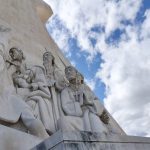
Prince Henry sails for Ceuta
This is the expedition usually taken as the opening of the Age of Discovery, and the fleet was fitted out at Porto. The citizens are said to have given all their meat to the ships and eaten the offal themselves. That is why the people of Porto are still called tripeiros, tripe-eaters, and why tripe stew is the city’s dish.
📍 If you go

2 One cape at a time — the road to India
India had been the destination from the start: to reach the spices — pepper, cinnamon, cloves — without paying Venice or the Arab traders. In 1488 Bartolomeu Dias rounded the southern tip of Africa, later named the Cape of Good Hope, and the door to the Indian Ocean stood open. In 1497 Vasco da Gama sailed from the beach at Belém in Lisbon, and reached Calicut in May of the following year.
How much that route was worth is legible today in the scale of the buildings at Belém. Jerónimos Monastery was paid for out of the spice trade, and ship ropes and sea creatures are carved into its stonework. Gama himself is buried inside it.
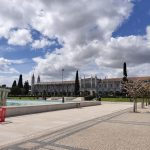
Vasco da Gama opens the sea route to India
He sailed from the beach at Belém in 1497 and reached Calicut in May of the following year. The spice wealth paid for Jerónimos Monastery, where his tomb now lies. Belém Tower was finished about twenty years later to guard the point of departure.
📍 If you go

3 The year everything moved at once — 1492
Five years before Gama sailed, three things happened in neighboring Spain in a single year: the fall of Granada, the last Muslim kingdom in Iberia; the edict expelling the Jews; and the departure of Columbus. Columbus had first tried to sell the king of Portugal on sailing west to India and been turned down. Spain took the bet, and a route opened to another continent across the Atlantic — which he went on believing was India.
Two years later, in 1494, Spain and Portugal used the Treaty of Tordesillas to divide the globe along a meridian in the Atlantic. Land found west of the line was Spanish, east of it Portuguese. That line, drawn without asking anyone who lived on the other side of the world, is the distant reason Brazil speaks Portuguese and the Philippines became Spanish. And at the far eastern end of the line lay Japan.
4 At the eastern end of the line lay Japan
Working eastward through Goa in India and Malacca on the Malay Peninsula, Portuguese sailors were blown onto the island of Tanegashima in 1543. The firearms they were carrying changed warfare in a Japan then at war with itself, and six years later Francis Xavier of the Jesuits landed at Kagoshima. Guns came first; Christianity and Portuguese sweets followed on the same route. Several Japanese words for those sweets are Portuguese: castella, konpeitō from confeito, and tempura.
Portuguese sailors are wrecked on Tanegashima, and firearms reach Japan
The eastern end of the Age of Discovery route was Japan. Guns arrived first, then Christianity and Portuguese sweets, all by the same sea route. Standing at the Monument to the Discoveries in Belém, you are standing at the other end of it.
📍 If you go
Macau, where the Portuguese were permitted to settle around 1557, was the hinge of that Japan trade. A regular run between Macau and Nagasaki carried Japanese silver and Chinese raw silk, at enormous profit. When Japan turned against Christianity, exiled Japanese Christians took refuge in Macau. The carved facade of St. Paul’s still shows a chrysanthemum motif that Japanese craftsmen are thought to have worked on.
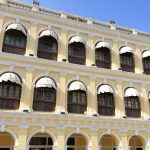
Portugal is allowed to settle at Macau
Ming China permitted a settlement, and it became the hinge of East Asian trade. The Jesuits began St. Paul’s in 1602; a fire in 1835 left only the facade. The wave-patterned pavement of Senado Square is the same design as Lisbon’s.
📍 If you go

5 The other way round: crossing the Pacific
Spain reached Asia going the other way. When Legazpi founded Manila in 1571, galleons began to run between Acapulco in Mexico and Manila. Mexican silver was exchanged in Manila for Chinese silk and porcelain: the moment a trading network first closed a circle around the world. In the walled city of Intramuros there was also a Japanese quarter, and the exiled Christian lord Takayama Ukon died there.
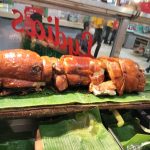
Legazpi founds Manila, and 333 years of Spanish rule begin
The walled city of Intramuros became the colonial capital, and galleons ran between here and Mexico. Spanish names on the Filipino table date from this period — lechon is lechón, suckling pig.
📍 If you go

6 The lead changes hands
In the seventeenth century the lead moved north from Iberia. The Dutch East India Company, founded in 1602, raised money widely through shares — a new mechanism — then sent out fleets and took Portuguese posts one after another. In Japan, the Dutch became the only European partner permitted to trade under seclusion. Portuguese ships were barred in 1639, and the Dutch factory moved to Dejima in Nagasaki in 1641.
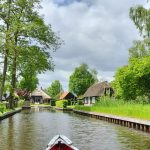
The Dutch East India Company (VOC) is founded
Often called the first joint-stock company. Asian trade paid for the threefold expansion of the canal ring from 1613, which is why the city is shaped like a fan. The houses along the canals are narrow because they were taxed on their frontage.
📍 If you go

The traces left behind turn up in unexpected places. Essaouira, on the Atlantic coast of Morocco, is where a later sultan had a port town laid out on a site the Portuguese had fortified in 1506 and abandoned within a few years. From the gun platforms on its walls you look out on the Atlantic the Portuguese ships sailed down.
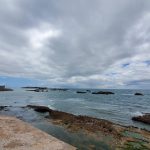
A sultan lays out Essaouira as a port town
On a site the Portuguese had fortified and abandoned in 1506, the sultan had a French engineer design a grid-planned port. Cannon line the European-style ramparts; inside is a maze of white houses. It prospered as Morocco’s Atlantic trading port.
📍 If you go

7 The empires left, and the taste stayed
Textbooks end the Age of Discovery with treaties and sea battles. But the surest trace you can meet while traveling may be food. The secret pastry of Jerónimos Monastery, built on spice money, passed to the shop next door when the monastery was dissolved in the nineteenth century, and the queue is still there. In Macau at the end of the twentieth century an Englishman remade that Portuguese pastry and sent it across Asia. The malasadas of Hawaii were left by Portuguese migrants who crossed to the sugar plantations in the nineteenth century.
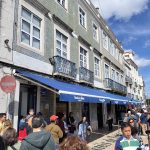
The monastery’s pastry goes on sale in a shop
When the monasteries were dissolved in 1834, a monk left the custard tart recipe with the sugar refinery next door. The shop that opened in 1837 is Pastéis de Belém, still beside the monastery. The monastery is World Heritage; the recipe is in a safe.
📍 If you go

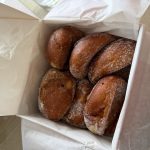
Portuguese migrants arrive in Hawaii from Madeira
They came all the way from an Atlantic island as contract laborers for the sugar plantations, bringing fried malasadas and a small four-stringed instrument that became the ukulele. A hot malasada in Honolulu is a nineteenth-century migrant’s food.
📍 If you go

Standing on the ground of this story
For the point of departure, Belém in Lisbon; for the eastern hinge, Macau; for the Pacific side, Manila. To walk the country as a whole, start from the Portugal travel guide. Other eras and other stories are in the history section, where the table pairs events with what you can still visit.
Sources for dates and names are behind the “Source” link on each event card.