Field notesJuly 2022 · four days on the island (3 nights in Oia + 1 in Fira, rental-car loop, sunset cruise)
Prices & rules last checkedJuly 2026
The world is drowning in photos of Santorini, but standing there teaches you something the photos don’t: this is not a place for pictures — it is a place to live for a few days on the edge of a cliff. The honest summary: a few hours off a cruise ship will not reach the essence of the island. Stay two or three nights in Oia and take a car around the island for a day, and Santorini changes shape in front of you. Here is how to do it.
How the island works — towns on the rim of a caldera
Santorini is the rim of a colossal volcanic caldera. The inner edge of the crescent-shaped island is a cliff several hundred meters high, and the white towns cling to that edge. Two towns matter most: Oia at the northern tip, famous for its sunsets, and Fira, the island’s hub for transport and practicalities. The caldera views are extraordinary from both, but their characters differ — Oia is quiet and upscale, Fira busy and convenient. The postcard Santorini you have in mind is concentrated in Oia.

Oia — blue domes, and Amoudi Bay below the stairs
Walking Oia is simple: follow the main street along the caldera and peel off into the lanes. The famous blue-domed churches appear in several spots, and they are most beautiful in the late-afternoon light when the white walls turn gold. Skip the blazing midday — the town belongs to you before 8 a.m., and again in the hour before sunset.

If your legs are willing, descend the nearly 300 steps from the edge of Oia to Amoudi Bay. Tavernas line the tiny cliff-foot harbor, and if you scramble around the rocks beyond, there is a natural cove with brilliantly clear water. Swimming beneath the cliff walls, looking up at deep-blue sea and red rock, is on a different level from any beach — just remember the way back is all stairs. Stay for the evening: grilled fish and a Greek salad at a taverna by the water.

One day around the island by rental car
Santorini’s depth lies inland too, a step back from the caldera rim. Buses will get you around, but renting a car (or an ATV) for a single day changes your freedom entirely. Our recommended loop is a set of three —
- Pyrgos — a quiet hill village inland, largely untouched by the crowds. Climb the white lanes to the church at the top for a panorama of the island and the Aegean
- Akrotiri — the “Pompeii of the Aegean,” a town buried by the great eruption about 3,600 years ago, with the roofed excavation site open to walk through (entry around €20; the major finds are in the museum in Fira, as of July 2026). See our detailed guide
- The wineries — the island’s volcanic soil raises Assyrtiko, its signature white, alongside the traditional sweet Vinsanto. Several large estates have tasting terraces with sweeping views, and a cave-built wine museum walks you through the island’s winemaking history


GetYourGuide
Book Santorini tours and experiences
Caldera sunset cruises, volcano and hot-spring boat trips, winery tours — the island’s best options for days without a rental car. Many with free cancellation.
See Santorini experiences →Fira — the cable car or the six hundred steps
Fira, the island’s capital, is the bus hub and the best place for shopping and dinner. Between town and the Old Port below the caldera runs a cable car (around €6 one-way, about 5 minutes) — but when cruise ships are in, waits can hit an hour. Rather than queue, you can walk the zigzag stairway of roughly 600 steps down; be warned that the climb back up in summer is a war of attrition, and note that the donkey rides on the steps have drawn growing animal-welfare criticism in recent years.
Getting there and where to stay
Reach the island by air from Athens (about 45 minutes) or by fast ferry through the islands. We crossed from Mykonos on a SeaJets hydrofoil (2–2.5 hours). Aegean ferries are wind-prone and delay-prone — never stack plans on the evening of a sailing day. For the room: if the budget allows, take the caldera side of Oia — the morning and evening views are most of what you are paying for, and they are worth it. On a tighter budget, Fira is the practical base for transport and food.
Practical notes for Santorini
- Best season — June to September is high season. July middays are scorching: walk the towns early and late. May and October bring thinner crowds and calmer prices
- Sunset positioning — the castle ruins in Oia are the classic spot and brutally crowded. Booking a caldera-side bar or restaurant a little away from it is far more comfortable
- The photography culture — the island is full of photographers; we booked a wedding shoot ourselves during the stay. At 8–9 a.m. the streets are empty for photos, and nobody blinks at a dress in the lanes — that is Santorini
- Prices — caldera-view restaurants run above big-city European levels. The inland villages and the Amoudi tavernas are far kinder
- Water — tap water is not for drinking; keep bottled water on hand
Where to go from here
- The country at a glance → Greece Travel Guide
- Compare all our destinations → Destinations
- More of Europe → Portugal · Spain · Morocco
The history here
Why the places, the food and the artworks in this article are where they are.
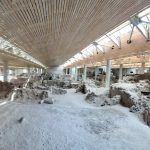
Thera erupts and seals the town of Akrotiri
At the height of Minoan civilization the center of the island blew apart and sank into the sea. The town survived under the ash, but unlike Pompeii not a single body has been found: the residents seem to have escaped. The crescent of cliffs in every photograph of Santorini is the scar of that eruption.
📍 If you go


