
Most people come to Santorini for the caldera views and the sunsets. But at the island’s southern tip, preserved under a single roof, lies a city buried whole by the eruption of about 3,600 years ago — more than 1,500 years older than Pompeii, the city Vesuvius entombed. And one difference is decisive: not a single human body has been found here. The inhabitants abandoned the city before the eruption came. This guide to walking the Akrotiri site is drawn from our own visit on foot (prices and hours as of our July 2026 check).
The short version — Akrotiri is “the ruin under a roof”
- The entire site is covered by one vast roof. It is the only sight on Santorini you can walk in shade at the height of a summer day — which, turned around, means there is no need to hunt for the cool hours
- One hour is enough. On our walk we reached the entrance at 11:33 and were out at 12:34. A wooden walkway loops the site — there is no way to get lost
- The frescoes are not here. The excavated wall paintings and the major finds have been moved to the museum in Fira. See only the site and you go home having missed half the city
The overall design of a Santorini stay is covered in our Santorini travel guide. The site requires a rental car or a bus ride down to the island’s southern tip, so the efficient move is to fold it into your island-loop day.
What happened 3,600 years ago — the city whose people vanished
Around 1600 BC (radiocarbon dating places it between 1620 and 1530 BC), the island produced a colossal eruption. Its center blew away and the sea poured in, creating the caldera cliffs we now call “the view”. That same eruption sealed the city at the southern tip under meters of pumice.
Here is where it parts company with Pompeii. Akrotiri has yielded no remains of eruption victims — not one body caught by the disaster. Precious metals are all but absent too. The conclusion: the inhabitants read the warning signs of the eruption — most likely earthquakes — and left the island deliberately, taking their wealth with them. What stayed buried were the buildings and the large tools they could not carry. Walking through, you can see millstones and jars sitting on the floors, as if the packing had been interrupted midway.
Highlight 1 — a three-story city, with ancient drainage
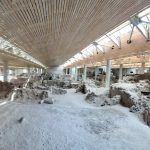
Step under the roof and the first shock is the city’s scale. Sheltered by the pumice, the buildings survive not just one story but with walls standing up to three stories high. Paved streets run between them, and the houses were fitted with drainage. It hits you that Bronze Age Mediterranean life was already this orderly.
The walkway is bridged over the excavation itself, alternating sections you look down into with sections where the walls stand close enough to touch at eye level. For photographs, go wide and play the curve of the wooden roof against the white pumice. You are indoors, so there is no wrestling with the light.
Highlight 2 — the frescoes are not here. Pair the site with Fira’s museum
What actually made Akrotiri famous is its wall paintings. The Spring Fresco with its landscape in bloom, the blue monkeys, the ship procession — these carriers of the Minoan eye have been moved from the site and are displayed at the Museum of Prehistoric Thera in Fira (entry around €10, as of July 2026). See the skeleton of the buildings at the site, then the paintings that once dressed those walls at the museum. Taken in that order, the city finally becomes three-dimensional.
Returning to Fira the same day is the ideal, but the southern tip is a long way from the island’s center. If your hotel is in Fira, the realistic split is the site in the morning and the museum toward evening.
Highlight 3 — the luxury of one hour in the shade
Midsummer Santorini sun is violent, and Oia and Fira offer almost no shade at all. Amid that, Akrotiri is the one major sight covered entirely by a roof. Spend the harshest stretch of midday here and the rest of your island day becomes remarkably easier. We did exactly that, giving the site the worst outdoor window of the day — 11:30 to 12:30.
A few minutes’ drive from the site is Red Beach, a small cove ringed by red cliffs — and with zero shade. The order that makes sense: Akrotiri at midday, Red Beach before evening.
Practical notes for the Akrotiri site
- Entry: around €20 (trending upward; pay on site). The Museum of Prehistoric Thera in Fira is around €10 (both are guide figures as of July 2026 — confirm the latest on site or officially)
- Hours: operated within a window of 8:00–20:00 (seasonal variation). Check just before your visit
- Time needed: about an hour for the site alone; half a day if you pair it with the museum
- Getting there: the island’s southern tip, by rental car or bus. It is a long way from Fira and Oia, so build it into an island-loop day
- Footwear: indoors, but the ground is sand and gravel. Walking shoes over sandals
If you are not renting a car, or want the context explained as you go, a local tour is the reliable route. Signage at the site is minimal, and having a guide completely changes what you see.
GetYourGuide
Find Santorini tours and tickets
Akrotiri site tours, winery visits, sunset cruises and more — handy for looping the island on days without a rental car.
See Santorini experiences →Where to slot it into the stay — its place within a Santorini day
Akrotiri is in the south of the island, in a different direction from walking Oia or Fira. Which day you slot it into changes how much of the moving is wasted.
- Get the shape of the island first: Santorini is the rim of a caldera left by a huge volcanic eruption, and the inside of the crescent is a cliff several hundred metres high. The two main towns are Oia, famous for the sunset, and Fira, the transport hub; the site lies south of both
- Put it on the car day: you can get there by bus, but hiring a car (or an ATV) for a single day changes the freedom entirely. Doing it on the same day as the inland sights spares you half a day of travel for the site alone
- Towns morning and evening, the site in the middle of the day: in Oia, the empty streets before 8 a.m. and the hour before sunset are for walking, and the blazing midday is not. Akrotiri, where you walk in shade under a roof, is exactly what that middle of the day is for
- The frescoes are in the museum in Fira, so making the return from the site run back through Fira lets you connect “the town and the frescoes” within the same day
So the most rational way to use this site is as the receptacle for the hot hours. The shape of the island as a whole is in the Santorini travel guide.
Where to go from here
- The island’s master plan → Santorini Travel Guide
- Where to base yourself → Where to stay in Santorini: Oia or Fira?
- Link it with Mykonos → Greek island hopping in practice
- Choose your next trip by history → History travel destinations
The history here
Why the places, the food and the artworks in this article are where they are.
Thera erupts and seals the town of Akrotiri
At the height of Minoan civilization the center of the island blew apart and sank into the sea. The town survived under the ash, but unlike Pompeii not a single body has been found: the residents seem to have escaped. The crescent of cliffs in every photograph of Santorini is the scar of that eruption.
📍 If you go


