
How Lisbon works
Lisbon is the westernmost city of the Eurasian mainland — a port town where seven hills rise along the north bank of the Tagus estuary.
As a traveler, there are three structural facts worth understanding before anything else.
- Belém, in the west — the World Heritage zone where the monuments of the Age of Discovery cluster
- Baixa-Chiado, in the center — the commercial grid the Marquis of Pombal rebuilt after the great earthquake of 1755
- Alfama, in the east — a maze-like old quarter dating back to the Middle Ages, and the home of fado
With three days, the most efficient plan is to take these three districts one per day, each in a single concentrated push. Combine trams, the metro and walking, and cross-district moves stay at roughly one per day.
Day 1: Belém — walking the Age of Discovery
In the morning, take tram 15E from Praça da Figueira out to Belém. The ride takes about 25 minutes; get off in front of the Jerónimos Monastery.
Jerónimos Monastery

Start with the Jerónimos Monastery. Regarded as the masterpiece of the Manueline style, it holds the tomb of Vasco da Gama, the tomb of the poet Luís de Camões, and — moved here in 1985 — the tomb of Fernando Pessoa. For the full historical backdrop of the Age of Discovery, see our deep dive, Walking the Age of Discovery.
⏰ Timing and ticketsDoors open at 9:30 (the church section from 10:30); closed Mondays (as of July 2026). The iron rule is to walk in right at opening — by late morning tour groups fill the cloisters and the photos you want become impossible. Admission is €18 for adults (the church section is free).
GetYourGuide
Find Jerónimos Monastery tickets and tours
A Manueline World Heritage Site with guaranteed queues, closed Mondays. Compare Lisbon entry tickets and guided tours in one place.
Browse tickets →Monument to the Discoveries
Five minutes’ walk from the monastery, along the Tagus, stands the Monument to the Discoveries. Erected in 1960 to mark 500 years since the death of Prince Henry the Navigator (d. 1460), the sculpture puts Henry at the prow, followed by Vasco da Gama, Magellan — and, remarkably, Francis Xavier.
How far these voyages reached: Xavier was the missionary who landed at Kagoshima, Japan, in 1549. The voyage that began at Belém — alongside the Portuguese firearms that arrived at Tanegashima in 1543 — quite literally reshaped Japan’s Warring States period.
Belém Tower
A 15-minute walk from the monument brings you to Belém Tower, on the bank of the Tagus. Built in 1515 as a defensive fortress and departure gate, it is now a World Heritage Site. It reopened at the end of May 2026 after restoration work and now runs on timed entry slots with a daily visitor cap, so booking ahead is the reliable move (admission €15, closed Mondays, as of July 2026).
Climb the tower’s narrow spiral staircase and the view opens across the mouth of the Tagus. Imagine how many tens of thousands of sailors set out from here for India, Brazil and Japan, and the tower becomes something more than a sight.
Finish at the birthplace of the egg tart

Before catching tram 15E back, stop at Pastéis de Belém for the original egg tart (pastel de nata) — baked to almost the same recipe since 1837. The literal real thing.
Day 2: Baixa and Chiado — a city redesigned after the earthquake
You cannot talk about Lisbon without the great earthquake of November 1, 1755. The quake — estimated at magnitude 8.5 — and the tsunami and fires that followed destroyed 85% of the city center. The reconstruction plan directed by the Marquis of Pombal, then chief minister, is precisely the grid of streets you see in the Baixa district today.
Start at Praça do Comércio

Get off the metro at Terreiro do Paço and walk into Praça do Comércio, one of Europe’s largest squares, facing the Tagus. Before the earthquake, the royal palace stood here.
The Santa Justa Lift

Baixa’s quiet celebrity is the Santa Justa Lift, a neo-Gothic iron elevator opened in 1902 and designed by the engineer Raoul Mesnier du Ponsard. Its resemblance to the Eiffel Tower invites the oft-repeated line that it is “the work of a disciple of Eiffel” — but no reliable record confirms it.
The queue is long, so walk up to the viewing deck from Largo do Carmo behind it and you skip the line entirely.
Chiado and Café A Brasileira
From the top of the lift, continue into Chiado. A Brasileira is the café the poet Fernando Pessoa frequented; his bronze statue sits outside.
Order an espresso (a bica) and spend a moment with Pessoa’s heteronyms — his invented alter-ego poets. For the intellectually curious, it is one of the city’s quiet pleasures.
GetYourGuide
Find a walking tour of Lisbon's old town
Wander Alfama's medieval maze with a local guide and more. Knowing the history makes Lisbon click into place. Easy to compare and book.
Browse tours →Day 3: Alfama — the medieval maze and the home of fado

The final day belongs to the city’s oldest quarter, Alfama — the district that miraculously escaped the 1755 earthquake, its medieval streetscape intact.
São Jorge Castle

Catch tram 28 first thing in the morning and ride up to São Jorge Castle. Moorish rulers built a fortress on top of Roman-era walls; after the Reconquista, Christian kings used it as a royal palace — 1,500 years of Lisbon’s history stacked in layers. For how to ride tram 28, and how to handle the crowds and pickpockets, see our complete guide to tram 28.
A night of fado
Spend the evening in Alfama listening to fado. The trick to a genuine experience is to skip the big tourist venues and choose a small fado house where locals go. Booking ahead is essential. For choosing a venue, reserving and listening etiquette, see our complete guide to a night of fado.
Fado is Portugal’s own music of saudade — longing, nostalgia, the ache for what cannot return. Listen to a few Amália Rodrigues recordings before you go and the depth of the live performance lands ten times harder.
Transport and entry costs (as of July 2026)
| Day | District | Main transport | Main fares and entry fees | Walking per day |
|---|---|---|---|---|
| Day 1 | Belém | Tram 15E round trip, on foot within the district | Tram €1.72 (zapping) / €3.30 bought on board. Jerónimos Monastery €18, Belém Tower €15 | ~6 km |
| Day 2 | Baixa-Chiado | Metro + lift + walking | Metro €1.72 (zapping) / 1-hour ticket €1.90 | ~5 km |
| Day 3 | Alfama | Tram 28 + walking | Tram €1.72 (zapping) / €3.30 bought on board. São Jorge Castle €17 | ~7 km (steep climbs) |
Fares are the official Carris/Metro rates revised in January 2026. Zapping is the pay-as-you-go rate on a rechargeable Navegante card (€0.50 to issue); on any day with four or more rides, the €7.25 24-hour pass (unlimited trams, metro, buses and funiculars) works out cheaper. Jerónimos Monastery and Belém Tower close on Mondays, so plan Belém for Tuesday through Sunday. Comfortable shoes are non-negotiable on all three days, and Alfama’s cobbles turn slippery in the rain.
Booking your stay and experiences
To turn the plan into a trip, you will still need a room, your experiences and a connection. Book your stay through whichever site you normally use and sort an eSIM before you fly; for the experiences, the fado night below is the one we recommend booking ahead.
GetYourGuide
Fado live show with tapas and drinks (Lisbon)
A live set by real fado singers, with Portuguese-style tapas and drinks included — a natural fit for your third evening. Book ahead online.
See the fado experience →Next steps
If you can stretch the trip by two or three days from Lisbon, these are the options.
- Sintra day trip — the royal summer retreat; Pena Palace is unmissable
- Coimbra overnight — the country’s oldest university (a World Heritage Site) and the Roman ruins of Conímbriga
- Óbidos day trip — a medieval village inside its walls, famous for ginjinha cherry liqueur
- Nazaré day trip — some of the world’s biggest waves and a clifftop old town
- Porto, two nights — the second city, the wine country, and Douro river cruises
Each day trip has its own full guide: Sintra day trip / Óbidos day trip / Coimbra guide / Nazaré day trip.
Where to go from here
These Travelers Route guides round out the rest of the trip.
- The country at a glance → Portugal Travel Guide
- Add the second city → Porto 2-day itinerary
- Do the whole country in a week → Portugal 7-day itinerary
- Compare all our destinations → Destinations
The history here
Why the places, the food and the artworks in this article are where they are.
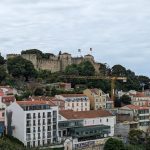
Afonso I retakes Lisbon with a crusader fleet
He persuaded northern European crusaders on their way to the Holy Land (English, Flemish and German) to stop, and took the Moorish castle after a four-month siege. São Jorge Castle on the hill is that castle, and the hilltop castle at Sintra fell the same year. Every wall you now use as a viewpoint changed hands in this one year.
📍 If you go
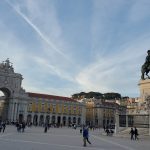
The Lisbon earthquake
On the morning of All Saints’ Day, earthquake, tsunami and fire destroyed most of the city. The Marquis of Pombal laid out a grid of new streets — the Baixa — braced with an anti-seismic timber cage. Azulejos covered the rebuilt facades, and their mass production dates from this period. Voltaire wrote it into Candide.
📍 If you go

The monastery’s pastry goes on sale in a shop
When the monasteries were dissolved in 1834, a monk left the custard tart recipe with the sugar refinery next door. The shop that opened in 1837 is Pastéis de Belém, still beside the monastery. The monastery is World Heritage; the recipe is in a safe.
📍 If you go


