
Tarragona is a Mediterranean coastal city about an hour from Barcelona by regional train. It flourished as Tarraco, provincial capital of the ancient Roman Empire, and it is a rare kind of place — an amphitheatre, a Roman aqueduct and ancient walls scattered through a living city. The entire old town was inscribed as a UNESCO World Heritage Site in 2000, and among those in the know it is the day trip for escaping the Barcelona crowds. This guide lays out a complete one-day route starting from Barcelona.
How Tarragona is laid out
Tarragona was founded by Rome in 218 BC as the base for the conquest of the Iberian Peninsula — the oldest Roman colonial city on the peninsula, with records of the emperors Augustus and Hadrian in residence. The Roman remains cluster on a height overlooking the Mediterranean, with the medieval Catalan town spreading out below.
- Upper town (Part Alta) — the cathedral, the Roman sites, the medieval old town. The heart of the historic walk
- Lower town (Part Baixa) — the railway station, the beach, the modern quarter. Restaurants and hotels
- The coast — Miracle beach, the Roman aqueduct (on the outskirts), Mediterranean beaches
Day-tripping from Barcelona, leave on a train around 9:00 and return on one around 17:00–18:00 — 6–7 hours covers the main sights. If ancient history is your thing, staying a night and digging in over two days is also worth considering.

Getting there from Barcelona
- Regional train (Rodalies R14 / R15 / R16) — about 1 h 5 min to 1 h 15 min from Barcelona Sants, around €8 one way (as of July 2026). It arrives at Tarragona station right in the city center, which makes it the default for a day trip (recommended)
- High-speed rail (AVE / Avant) — fast at 30–35 minutes, but it arrives at Camp de Tarragona station about 10 km outside the city, and connecting buses are infrequent. Not recommended for a day trip
- Rental car — about 100 km on the AP-7 motorway, around 1.5 hours. Handy if you also want to string together the coastal villages
⚠ The trapBeware the “station trap”: book the high-speed train for its tempting 30–35 minute ride and you arrive at Camp de Tarragona, about 10 km from town. Connecting buses are few, and door to door you often end up slower than the regional train. For a day trip, take the regional line to Tarragona station in the city center.
From Tarragona station (city center) it is a 15-minute uphill walk to the upper town, or 5 minutes on a city bus (€1.50). In summer, skip the climb and take the bus.
The essential sights — five Roman ruins in a row
The amphitheatre (Amfiteatre Romà)

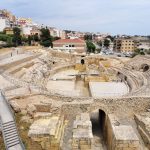
Built in the 2nd century on a cliff above the Mediterranean, the amphitheatre held 14,000 spectators in its day. Gladiator bouts, wild-beast spectacles and the execution of persecuted Christians took place here, and the remains of a 6th-century Visigothic basilica commemorating the martyrs — and, above it, a 12th-century Romanesque church — still stand at the arena’s center. It is Tarragona’s finest viewpoint — the sight of the sea from the tiered seating is stunning. Entry €5 (as of July 2026), about 45 minutes.
GetYourGuide
Find tours and tickets for Tarragona
Compare and book day tours from Barcelona and guided tours of the Roman ruins — and skip the DIY legwork.
Browse tours and tickets →The cathedral (Catedral de Santa Tecla)

Built between the 12th and 14th centuries, this is Catalonia’s largest cathedral, Gothic and Romanesque intertwined. The site embodies layer upon layer of civilizations: first a Roman temple of Jupiter, then a Visigothic church, then a Moorish mosque. The highlights are the cloister — 295 carved capitals — and the Diocesan Museum (Museu Diocesà) entered from it, with its collection of Gothic art. Entry €12.50 (a combined ticket for cathedral + cloister + Diocesan Museum, as of July 2026), about an hour.
The Roman aqueduct (Pont del Diable / the Devil’s Bridge)

Four kilometers north of the city stands the Roman aqueduct known as the Devil’s Bridge (built in the late 1st century). At 217 m long and 27 m high, its double tier of arches once carried the water supply of ancient Tarraco. It is one of those rare ruins you can still walk across the top of — allow an hour (EMT Tarragona city bus lines 5 and 85 toward Sant Salvador, about 15 minutes, “Pont del Diable” stop. Free entry).
Alongside Segovia’s, it is counted among the three great Roman aqueducts of Spain. On a day trip, slot it into the cooler hours of the morning or late afternoon.
The ancient walls and the Praetorium (Passeig Arqueològic)
The archaeological promenade along the Roman walls (Passeig Arqueològic) is a 1 km walkway skirting ramparts first raised in the 3rd century BC. Defensive towers, gates and ancient cisterns punctuate the route, with the Roman, medieval and modern layers of the city in a single view. About an hour, entry €5 (as of July 2026).
The adjacent Praetorium tower opens the underground structure of the Roman governor’s residence to visitors — a site said, by some records, to have hosted the emperor Augustus. A combined ticket (€5) covers it together with the chariot-racing circus (Circ Romà).
The Roman circus (Circ Romà) and its underground galleries
The chariot-racing circus (1st century) was a colossal entertainment venue seating 30,000 in its day. Above ground little remains beyond markers, but the underground galleries survive complete and can be visited (combined entry with the Praetorium tower €5, about 30 minutes). From the Middle Ages onward, houses were built directly on top of the circus — a rare piece of urban layering you can walk through.
Eating and souvenirs
Tarragona’s food culture sits at the crossroads of the Mediterranean and the inland farms — you get both seafood and country cooking.
- Calçots — the winter specialty born in nearby Valls: long green onions charred over coals and eaten with romesco sauce. January–March only, at the specialist restaurants of Valls or as seasonal menus in town, €15–25
- Rice dishes and seafood — as fresh as a coastal city promises. In the upper town (Part Alta), El Llagut (known for rice dishes with local seafood) or Les Coques, a traditional house founded in 1984, €18–25
- Romesco sauce — Tarragona’s own sauce of tomato, almond and paprika. Jarred for the trip home, €5–10
- Xató — a salad of dried cod and anchovies with a romesco-family dressing. €10–12
If you stay the night
Most visitors day-trip, but an overnight is worth it if you want the Roman sites and the cathedral without a clock running. In summer, the beach joins the program.
- Upper town (around the cathedral) — atmosphere first; the evening streets are a pleasure; often no parking
- Lower town (station and beach) — good value, easy access, beach within walking distance in summer
Practical notes for Tarragona
- Best season: April–June and September–October — stable Mediterranean weather. July–August adds the beach but also the crowds; December–February is cool, with many places on shorter hours
- Time needed: the five main Roman sites at a brisk pace take 5–6 hours; add the aqueduct and it is 8 — and two unhurried days are worth it too
- Roman sites combined ticket: €15 covers the sites run by the municipal history museum (MHT) — the amphitheatre, the circus and Praetorium, the walls promenade and more (individual entry €5 each, as of July 2026). The cathedral is not included — €12.50 separately (Diocesan Museum included)
- Language: Catalan and Spanish side by side. English works at the sights; local eateries are Spanish-only
- Midsummer caution: in July–August, concentrate the open-air ruins into the morning (10:00–13:00) and retreat to the beach or your hotel in the afternoon — treat heatstroke as a real risk
- Meal times: lunch 13:00–15:00, dinner 21:00–23:00. As in Barcelona, arrive at 18:00 expecting dinner and you will find the kitchens closed
Where to go from here
- Barcelona 3-Day Itinerary — the Catalan capital and your starting point for Tarragona
- Spain Travel Guide — the gateway to all our Spain coverage
- Madrid 3-Day Itinerary — the story of Spain’s other capital
- Toledo Travel Guide — a day trip from Madrid to the World Heritage city of three cultures
The history here
Why the places, the food and the artworks in this article are where they are.
Roman legions land in Iberia and found Tarraco
In the Second Punic War the Scipio brothers landed here to get behind Carthage, and the port became the capital of Roman Hispania. The amphitheatre faces the sea; outside the walls an aqueduct still carries its water channel across a valley. A provincial capital of Rome sits an hour from Barcelona.
📍 If you go


