The phrase “all roads lead to Rome” was not a metaphor but a description of a road network. For a few centuries one state ringed almost the whole Mediterranean and laid roads, aqueducts and cities across it — and a surprising amount of it is still standing. This page follows the story of the Roman Empire through places you can still stand in today. The card under each chapter leads to the article for getting there.
In short
- An Italian city-state spread, over roughly a thousand years from the start of the Republic to the end of the Western Empire, until it called the Mediterranean “our sea”.
- Tarragona as a provincial capital, the Colosseum and the Roman Forum at the center, and the Pantheon, which has not lost its roof in nearly two thousand years — all of them can still be walked into.
- After the empire fell, its roads, its cities and its language remained as the skeleton of Europe.
1 The state that ringed a sea
In 218 BC the Carthaginian general Hannibal crossed the Alps with elephants and invaded Italy. Fighting at home, Rome also sent an army to the Iberian Peninsula to get behind the enemy. The port where the Scipio brothers landed became Tarraco — today’s Tarragona. The expedition was meant as defense, but winning it left Rome holding the peninsula. That pattern repeated, and the lands around the Mediterranean became provinces one by one.
What makes Tarragona interesting is that it was not the capital but a provincial capital. An amphitheatre, city walls, an aqueduct outside the town: the sense that even a regional city got all this says more about the depth of the empire than Rome itself does. It is an hour by train from Barcelona.
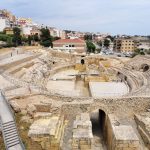
Roman legions land in Iberia and found Tarraco
In the Second Punic War the Scipio brothers landed here to get behind Carthage, and the port became the capital of Roman Hispania. The amphitheatre faces the sea; outside the walls an aqueduct still carries its water channel across a valley. A provincial capital of Rome sits an hour from Barcelona.
📍 If you go

2 Standing at the center
In AD 80 the emperor Titus opened a 50,000-seat arena with a hundred days of games: the Colosseum. Next to it the Roman Forum had been the political center since the Republic, the place of the senate, the courts and the triumphs. The two together are something like a national stadium built next to the seat of government, and the arrangement of power two thousand years ago is legible on foot.
The Colosseum is incomplete for more than seismic reasons. From the Middle Ages onward it served as a heap of ready-cut stone for churches and palaces. It was not so much destroyed as used — and much of ruined Rome lives on that way, inside the buildings of later centuries.
3 A roof that lasted 2,000 years
Almost every Roman building lost its roof; there is one exception. The Pantheon, rebuilt by Hadrian around AD 126, is still among the largest unreinforced concrete domes in the world, and rain and light fall straight through the opening at its crown. The reason it survived is simple: it was converted into a church in 609. Only the buildings that became places of worship escaped being quarried.
4 The northern edge
The northern frontier of the empire ran roughly along the Rhine and the Danube. One of the towns that grew out of a legionary base on the Rhine was raised to the rank of colonia in AD 50, after the empress Agrippina, who had been born there, pressed her husband the emperor Claudius to do it. The town was named Colonia Claudia Ara Agrippinensium; the long name wore down to today’s Cologne. Cologne Cathedral stands on ground that has been the center of the city since Roman times.
Across the sea in Britannia, after the invasion of AD 43, a town of bridge and market called Londinium grew up on the Thames from about AD 47. The British Museum’s Britain galleries hold the finds from that Roman London. A surprising number of major European cities began as legionary bases or colonies.
5 What was left after the fall
In 476 the Western empire ended. But much of the skeleton of Europe a traveler meets is Roman inheritance. The languages spoken — Portuguese, Spanish, French, Italian — are provincial Latin, drifted apart. The positions of cities and the lines of the roads became the base layer under today’s motorways and railways. And some places, like Toledo, run on from being the capital of the Visigothic kingdom that took the empire’s place into the Middle Ages.
The sequel to this story is, in fact, another story on this site. Within the framework of the Mediterranean world Rome left behind, Islam and Christendom crossed, and at its westernmost edge the Age of Discovery began in Portugal. History does not end in one place and start in another; it accumulates on the same ground.
Standing on the ground of this story
For the center, two nights in Rome; to feel the scale of a province, a day trip to Tarragona. The northern edge is Cologne and London. The story continues in the Age of Discovery. Other eras are in the history section.
Sources for dates and names are behind the “Source” link on each event card.