Field notesSeptember 2023 · based on first-hand eating in Manila and Bohol
Prices & rules last checkedJuly 2026
Ask travelers what Filipino food actually is, and most will pause. It tends to hide in the shadow of Thai and Vietnamese cooking, but the reality is a food culture with sourness, fat and sweetness in three-part harmony — cooking built for white rice. Here are the five classics to eat first, and how to pick the restaurants.
The short version — Filipino food is cooking for rice
- Make sisig your first meal: finely chopped pork hissing on a hot iron plate. As a partner to beer or to rice, nothing in the country beats it
- For soup, sinigang: the national dish powered by tamarind sourness — arguably Asia’s sourest. You quickly learn that sourness is a virtue in a hot country
- When in doubt, go to a modern-Filipino restaurant: popular Manila spots like Manam, serving the classics with today’s sensibility, are a first-timer’s shortest route
- Keep two dessert slots open: leche flan (an ultra-dense custard) and halo-halo — served at a scale of generosity all its own
Sisig and sinigang — sizzling fat and tamarind sour


Sisig is pork — cheek among other cuts — chopped fine, tossed with calamansi (the Filipino citrus) and chili, and served spitting on a hot iron plate. Break a raw egg over it, stir, and you have the ultimate thing to pile on rice. Its counterpart, sinigang, is a loaded soup where tamarind sourness plays the lead. The first spoonful makes you yelp — and then, eating it in the heat and humidity, you understand exactly why this sourness soaks into the body. It comes in pork, shrimp and fish versions; when in doubt, start with pork sinigang.
Inasal and lechon — charcoal chicken and the whole roast pig


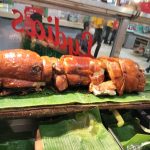
Chicken inasal is chicken marinated in annatto (achiote seed) and lemongrass and grilled over charcoal. At the specialist chains, unlimited rice refills come as standard equipment, and locals eat it gloriously with their hands (there is always a hand-washing station, so do try it the local way). Then comes the king of festival cooking, lechon — a whole roast suckling pig, carved to order, the crackling skin and rich meat taken with liver sauce or vinegar. The rows of glossy, burnished roasts at markets and specialist shops are the national sign that today is a day of celebration.
Dessert and restaurant strategy — leche flan and the modern-Filipino move


First among the desserts is leche flan — a custard so extravagant with egg yolk that it is several times denser than any ordinary crème caramel. The king of shaved ice, halo-halo (Tagalog for “all mixed up”), stacks purple-yam ice cream, flan, sweet beans and nata de coco in extravagant layers — the towering original makes every imitation abroad look timid. As for where to eat: in Manila, head for a popular modern-Filipino restaurant like Manam, where the classics come in S/M/L sizes — which makes conquering all five dishes realistic even for a small group. Mall branches in Makati or BGC also take hygiene worries almost entirely off the table.
Practical notes for eating in the Philippines
- Going rates — 200–400 pesos a meal at a local eatery, 400–800 at a mall restaurant, and even Manam-class favorites run about 1,000–1,500 pesos a head (as of July 2026; moves with exchange rates)
- The first five — sisig → sinigang → chicken inasal → lechon → leche flan. In that order, no misses
- Hygiene — save the street-stall debut until your body has adjusted. Choose carefully where you take ice and raw vegetables, and stick to bottled water
- Ordering — adding “extra rice” is completely normal. At Manam-style places the S/M/L system means ordering size S to cover more dishes
- Entry — many nationalities can visit visa-free for up to 30 days, and eTravel registration (free) is required — check the rules for your passport. Details in our Manila & Bohol itinerary
Where to eat — choosing places and fitting them into the trip
Filipino food puts the same dish names on menus from street stalls to fine dining, so where you eat changes the impression entirely.
- A buffet on the water is an option: on the Loboc River on Bohol, a lunch cruise on what is effectively a roofed floating restaurant (with buffet, around 1,000 pesos) is the local speciality. It digests scenery and a meal at once, which tells on a packed day (as of July 2026)
- In Manila, eat it as city food: for the same dish, a local canteen and a modern place inside a mall differ in both price and taste. Trying both within a single day gives you the range of this country’s food directly
An itinerary that pairs island and city is in the Manila and Bohol week.
Where to go from here
- The full trip design → Manila & Bohol Itinerary
- The island scenery day → Bohol Day Tour Guide
- The country at a glance → Philippines Travel Guide
- Choose your next trip by food → Food Travel Destinations
The history here
Why the places, the food and the artworks in this article are where they are.
Legazpi founds Manila, and 333 years of Spanish rule begin
The walled city of Intramuros became the colonial capital, and galleons ran between here and Mexico. Spanish names on the Filipino table date from this period — lechon is lechón, suckling pig.
📍 If you go


