Field notesAutumn 2019 · based on a first-hand week-long stay
Prices & rules last checkedJuly 2026
San Francisco, where Alcatraz floats into view from the top of the hills, and Santa Cruz, the surf town waiting one mountain ridge away. The great appeal of this corner of California is that a single drive strings together a big city, a laid-back seaside town and Silicon Valley. Here is how to build a combined San Francisco and Santa Cruz trip.
The short version — three days of city, three days of coast
- Three days reaches San Francisco’s core: Lombard Street, the cable cars, Fisherman’s Wharf, Alcatraz — all doable on foot plus cable car ($9 a ride, or $15 for an unlimited day pass)
- Book Alcatraz weeks ahead: the official tour (around $47.95) sells out as a matter of course. Reserve the moment your itinerary firms up
- Then rent a car for Santa Cruz: about 1.5 hours over the mountains on CA-17 brings you to a surf town of clifftop coastline and a retro amusement park — with a Silicon Valley pilgrimage stop in Cupertino along the way
- ESTA costs $40.27 (revised January 2026) if you enter under the US Visa Waiver Program. Never apply anywhere but the official site
Walking the hills — Lombard Street and the cable cars

“The crookedest street in the world,” Lombard Street is a brick-paved roadway that descends a 27% grade through eight hairpin curves. Viewing is free, and from the top of the hill the view runs in a straight line to Coit Tower and the bay. It sits in the residential neighborhood of Russian Hill, so be considerate of the people who live there.

On the cable cars, running since 1873, the ride itself is the sightseeing. Fares are $9 per ride (any distance); if you plan to hop on and off, the Visitor Passport ($15 a day via the MuniMobile app) is far better value (as of July 2026). Stand on the outside step of a Powell–Hyde car as it drops downhill, and the bay and Alcatraz appear and vanish between the houses — the best value attraction in San Francisco.
Stars of the bay — Alcatraz and clam chowder

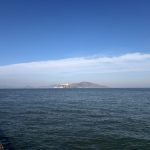
You reach Alcatraz Island, the former federal penitentiary in the middle of the bay, on the official tour departing Pier 33 (Alcatraz City Cruises; day tour around $47.95, audio tour included, as of July 2026). Walking the cellblock that once held Al Capone, guided by an audio tour built from the voices of former guards and former inmates, is an extraordinary experience. But sellouts weeks in advance are the norm — book the moment your dates are set.

At Fisherman’s Wharf, home of the ferry pier, order the clam chowder bread bowl at Boudin Bakery, founded in 1849. Served in a hollowed loaf of sourdough — the tangy bread this city has baked since the Gold Rush — and eaten bowl and all, it warms you right through the fog chill. At Pier 39, watch enormous California sea lions commandeer the docks.
A Silicon Valley pilgrimage — detour to Apple

If your route south from San Francisco to Santa Cruz passes Cupertino and Mountain View, a Silicon Valley pilgrimage makes a worthy detour. The company store at Apple’s old headquarters, Infinite Loop, which we visited, closed in January 2024; visits are now consolidated at the Apple Park Visitor Center beside the spaceship campus (free to visit; store, café and rooftop terrace, as of July 2026). Much of the exclusive merchandise can be bought nowhere else — perfect souvenirs for the tech lovers in your life.
Santa Cruz — clifftop coastline and a retro boardwalk

Cross the Santa Cruz Mountains on CA-17 and the air changes. Santa Cruz is one of the birthplaces of California surfing, and West Cliff Drive along the shore is a spectacular walking route of cliffs and coves in succession. Surfers wait for sets below, and with luck a sea otter floats past. The face of the town is the Beach Boardwalk, California’s oldest amusement park, opened in 1907 (free entry; rides $3–5 each; weekends only in the off-season). With a wooden coaster listed as a National Historic Landmark, it is a living piece of American retro.

If you want to move, we recommend a kayak from the harbor. Paddle out toward the lighthouse on the jetty and sea lions bark under the pilings while the coastline scrolls by at eye level with the water. Rentals are available same-day at the harbor shops (conditions permitting — waves and wind decide).
Capitola — the pastel hideaway beach town

Ten minutes by car from Santa Cruz, Capitola is one of the West Coast’s oldest beach resort towns, its pastel cottages lining the lagoon where the river meets the sea. Sometimes called the “Venice of California,” with a small pier and a compact village of cafés and wine bars, it offers exactly the kind of quiet that closes out a road trip well.
Practical notes for San Francisco and Santa Cruz
- ESTA — $40.27 (revised January 2026; valid two years) for Visa Waiver Program travelers. Apply only at the official esta.cbp.dhs.gov
- City transit — cable car $9 per ride; unlimited Muni Visitor Passport $15 a day (MuniMobile). You do not need a car in the city (parking gets expensive)
- Safety — tourist areas are fine in daylight, but rental-car break-ins are a real risk: the iron rule is to leave nothing in the car, ever. After dark, choose your neighborhoods
- Getting to Santa Cruz — about 1.5 hours by rental car via CA-17. Routing via Silicon Valley on I-280, then 85 and 17, makes the detour easy
- Climate — San Francisco stays cool even in midsummer, and the fog (“Karl the Fog”) chills mornings and evenings. Layers are essential. The Santa Cruz side is sunnier
- Tipping — 15–20% is standard at restaurants
Where to go from here
- Across the Pacific to the islands → Hawaii Two-Island Itinerary
- More colorful seaside towns → Copenhagen Travel Guide
- Choose your next trip by scenery → Scenic Travel Destinations
The history here
Why the places, the food and the artworks in this article are where they are.

The Gold Rush
A village of about a thousand people became a city of twenty-five thousand within two years of the discovery of gold. Houses went up on slopes too steep for horses, and in 1873 the cable cars began to climb them. The cars still running are evidence of what those hills did to the city.
📍 If you go
Alcatraz becomes a federal prison
The island in the middle of the bay went from fortress to military prison, and from 1934 held federal inmates including Al Capone. The currents were said to make swimming away impossible; it closed in 1963. It is now a national park you reach by boat.
📍 If you go


